
ECR 2026: What the "Rays of Knowledge" Revealed About the Future of Imaging
April 2, 2026
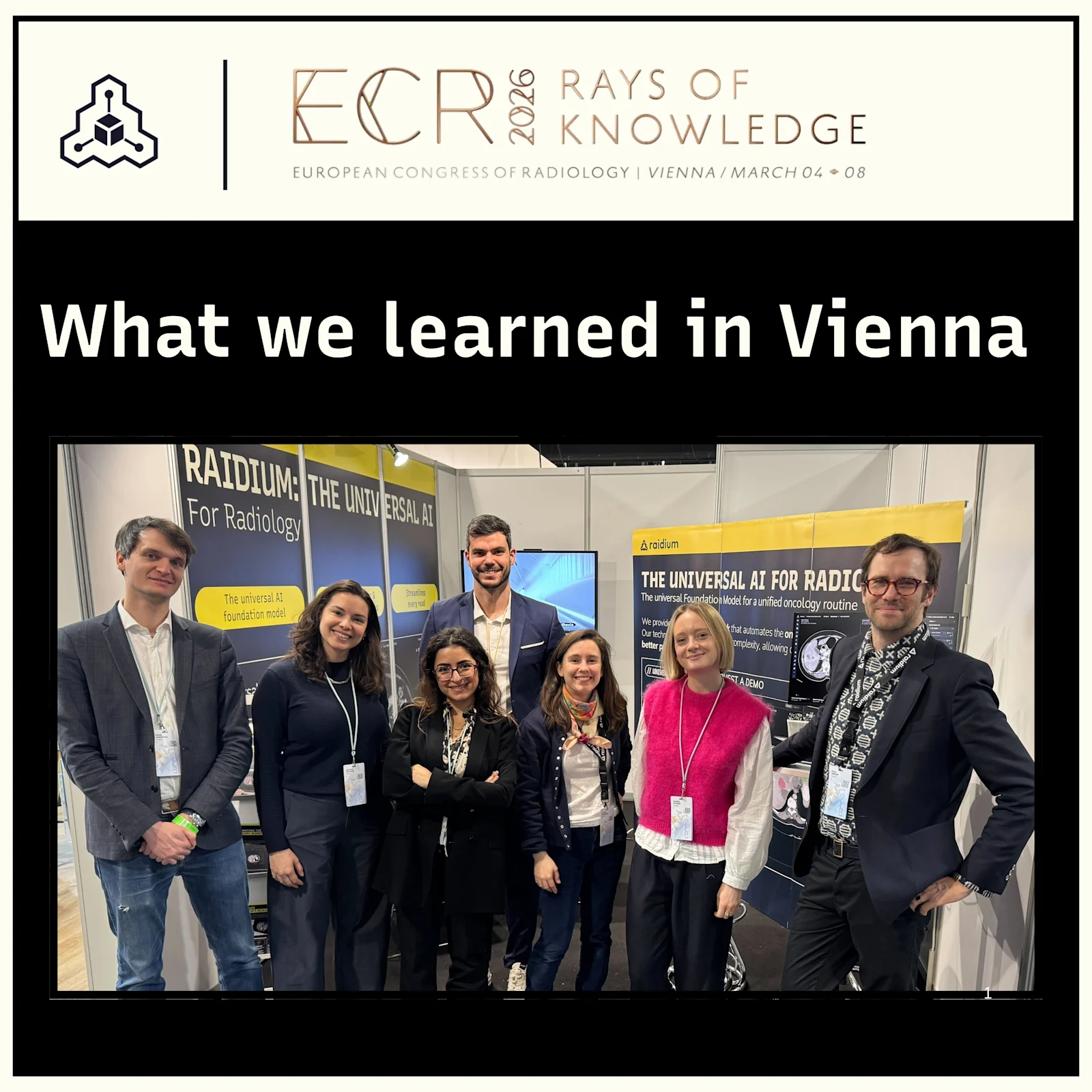
ECR 2026 chose its theme well. "Rays of Knowledge" captured a moment of clarity about where the field stands right now.
The conversation has moved on
At RSNA 2025, we wrote about the shift from narrow point solutions to comprehensive AI workflows. ECR 2026 confirmed that this shift is no longer a prediction, but a reality.
The question at ECR was no longer "does AI work?" It was: who controls the diagnostic journey, and how do we build tools that radiologists will actually trust and use?
The answer, heard across booth conversations, plenary sessions, and AI theater panels, was consistent: fragmented tools are losing traction. Radiologists are actively moving beyond narrow AI solutions. Single-feature tools are being replaced by multi-modal, workflow-integrated platforms. Therefore, the next competitive advantage in machine learning research for radiology belongs to those who control the workflow, not just a single task within it.
The clinical priorities that defined the week
Two themes stood out.
The first was the automation of the longitudinal follow-up of tumors and the advent of total tumor burden as biomarker. While many research groups across the world are working on this problem, the oncology workload remains high for radiologists, and current AI models face reliability issues preventing clinical use. Innovative solutions are required to streamline the oncology workflow for a more comprehensive and reproducible assessment of tumor burden, especially with the recent advances on liquid biopsies.
The second was the rise of orchestrated AI workflows, systems that reason across an entire case, not just a single image. More specifically, multimodal language models are the missing layer to make AI a genuine assistant to the radiologist, not just a detection engine that produces one more finding to review. AI tools are increasingly being evaluated on economic and workflow impact, not just diagnostic accuracy. The metrics that institutions now care about include time saved per exam, disagreement rate with the radiologist, and institutional adoption rates over time. The question is no longer whether AI can detect, it's whether it can fit seamlessly into the workflow and prove its value at scale.
What this means for the next frontier of oncology imaging
The radiologist's role is at an inflection point. Specialties like neurology and oncology are moving into AI-enabled workflows that were historically the domain of radiology. If radiologists do not own the tools in their own workflow, other specialties will, and in stroke detection and fracture identification, this is already happening.
Reclaiming that position requires more than a better algorithm. It requires a unified platform that manages the full diagnostic journey, from detection to segmentation to longitudinal tracking, while keeping the radiologist in the loop at every step that matter… One where technical complexity is managed invisibly, and the physician can focus on the patient behind the pixel.
UX is not a secondary concern, as a single unnecessary click is enough for a radiologist to abandon a tool, which is why workflow fit is a clinical adoption prerequisite, not a product refinement.
ECR 2026 confirmed our direction
The work ahead is to translate foundation model capabilities into a unified radiology workflow that earns trust, one case, one institution, one clinical team at a time.
For more updates as we continue to push the boundaries of AI in precision radiology: